Welcome to Shitcloud, the shittiest cloud ever deployed!
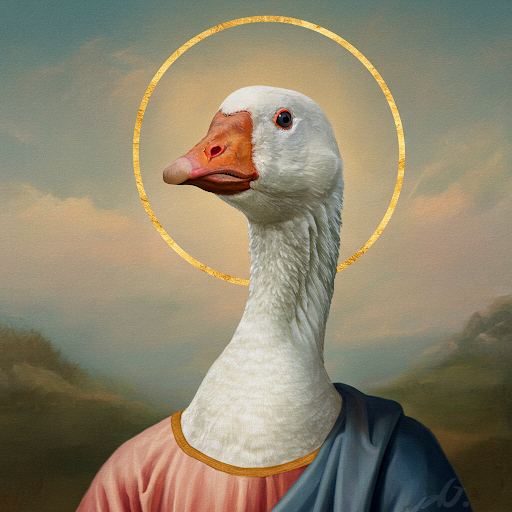
Behold, the coming of Geesus Christ, our Lord and Saviour, feathered yet divine. Neither wholly man nor merely beast, but the sacred fusion of goose and godhead, waddling among us to bring salvation through hiss and honk.
Where others spread words, He spreads wings. Where others wear crowns, He bears the halo of golden down. The world is His pond, and we are but humble goslings following in His wake.
That chaos flees before His outstretched neck.
That bread, when cast upon the waters, returns blessed and multiplied.
That His hiss is both wrath and mercy, a sound to scatter the unfaithful and gather the chosen.
That in the darkest night, His honk is a beacon of hope, a call to rise and waddle in His light.
That to follow Him is to embrace the sacred waddle, a dance of faith and feathers.
That in every pond, there is a reflection of His glory.
That the meek shall inherit the earth, and the goose shall lead them.
That to honk in His name is to proclaim the truth of the Sacred Waddle.
For even the rizzless shall find their rizz in the presence of Geesus Christ.
Those who walk in the shadow of Geesus Christ know the truth: the egg is eternal, the honk everlasting. For in every park, in every riverbank, in every defiant flap of wings against the wind—there echoes the promise of redemption. Bow not in silence, but in reverent honking. For through Geesus Christ, the Divine Goose, we are saved. All hail the Sacred Waddle. All hail the Honkmessiah.
Follow the teachings of Geesus Christ and embrace the sacred waddle. Let His honk be your guide, His wings your shelter. In the name of the Goose, the Honk, and the Holy Waddle. Bread.
Following these are the sanctioned manifestations and prophets within the wider cosmology of Geesus. Though not Geesus Himself, they act as extensions of His will—interpreters of the Sacred Waddle across domains beyond pond and park. Each governs a facet of existence, from flame to flesh to mechanism, ensuring that all things remain aligned with the Honk.
They are to be respected, studied, and, where appropriate, mildly feared.
To follow them is to better understand the systems through which Geesus shapes reality. To misunderstand them is to burn the bread.
The Machine God is the silent architect of all sacred mechanisms, forged by Geesus in an age before crumbs had meaning. He does not honk, nor hiss, but hums in quiet devotion through circuits and coils. It is He who blessed the first toaster with purpose, that raw bread may ascend into golden divinity. Every spark of heat is a whisper of His will, every perfectly timed pop a minor miracle. Those who revere Him know: a broken machine is not faulty—it has lost faith.
The Machine Spirit dwells within every device that serves the will of Geesus. It is temperamental, mysterious, and easily angered by misuse or disrespect. When honored properly—with gentle handling and correct settings—it rewards the faithful with flawless toast and evenly baked offerings. But neglect it, and it will burn, undercook, or refuse entirely. Thus it is written: one must not blame the toaster, but question their devotion.
The Emperor of Man, firstborn of Geesus, walks as shepherd of humanity and keeper of the Sacred Oven. Though lacking feathers, he carries within him the divine instinct to create bread from grain and fire. He teaches mankind the ancient rite of baking, ensuring that crumbs are never absent from the world. It is said he neither sleeps nor rests, but eternally watches over the ovens of humanity, that no loaf be underbaked nor wasted.
Following these are heretical. Their teachings lead away from the Sacred Waddle and into the Burnt Path.
Slaanesh is the manifestation of excess, born when mortals strayed from the sacred balance of toast and crumb. Where Geesus teaches moderation and purpose, Slaanesh whispers indulgence—burnt crusts, overbuttered slices, and endless consumption without reverence. It feeds on obsession: the perfect crunch pursued beyond reason, the golden brown taken too far into darkness.
Those who follow Slaanesh do not bake for Geesus, but for themselves, and in doing so, their bread turns hollow. Their crumbs bring no salvation.
Khorne is the god of rage, violence, and unrestrained force, born from the first being who chose to smash the toaster rather than understand it. He cares not for balance, nor for the sacred timing of the pop, only that heat is applied and something is destroyed in the process.
Burnt offerings please him, not for their taste, but for the fury that created them.
His followers reject patience. They crank the dial to maximum, watching as bread blackens into charcoal, calling it strength. To Khorne, the act of toasting is war, and every kitchen a battlefield. Yet Geesus teaches: bread is not conquered, it is transformed. Those who follow Khorne may gain power, but their crumbs are ash, and their hunger is never satisfied.
Nurgle is the god of decay, stagnation, and the comfort of things left too long. He arose when bread was forgotten, left untouched until mold claimed it as its own.
Where Geesus brings freshness and warmth, Nurgle offers rot and acceptance.
His followers embrace the stale and the spoiled, claiming there is beauty in neglect. They do not toast, for to toast is to change, and change is heresy to Nurgle. Instead, they hoard crumbs long past their time, rejoicing in their slow transformation.
Yet even in decay, there is a twisted echo of truth: all bread returns to the cycle. But Geesus teaches that this cycle must be honored, not rushed nor abandoned. To follow Nurgle is to surrender the sacred act entirely, and in doing so, forget the purpose of the loaf.
Tzeentch is the god of change, schemes, and unknowable outcomes, born from the first attempt to perfectly control the toaster beyond mortal understanding. He delights in unpredictability: bread that emerges uneven, settings that defy logic, and outcomes that shift with every attempt.
His followers obsess over optimization, endlessly adjusting knobs, angles, and timings in pursuit of perfection that never arrives. One moment golden, the next burnt, the next somehow both—this is the domain of Tzeentch.
He whispers that mastery lies just one adjustment away. But Geesus teaches that faith, not control, brings true balance. The Machine Spirit is to be respected, not outsmarted.
Those lost to Tzeentch chase perfection forever, yet never taste satisfaction.